What Is Dota 2 and Why Is It Hard
Dota 2 is a 5v5 strategy game where two teams fight to destroy the enemy base. Each player controls a single hero with unique abilities. Matches last anywhere from 20 minutes to over an hour, and no two games play out the same way.
It has a reputation for being one of the hardest games to learn. That reputation is deserved. Dota 2 has over 120 heroes, hundreds of items, and a map full of systems that interact with each other in non-obvious ways. The learning curve is steep and the playerbase is unforgiving.
But here is the thing: you do not need to understand all of it to start playing. You need to understand the basics well enough to contribute, and then the rest comes with time. This guide gives you exactly that.
The Map Explained
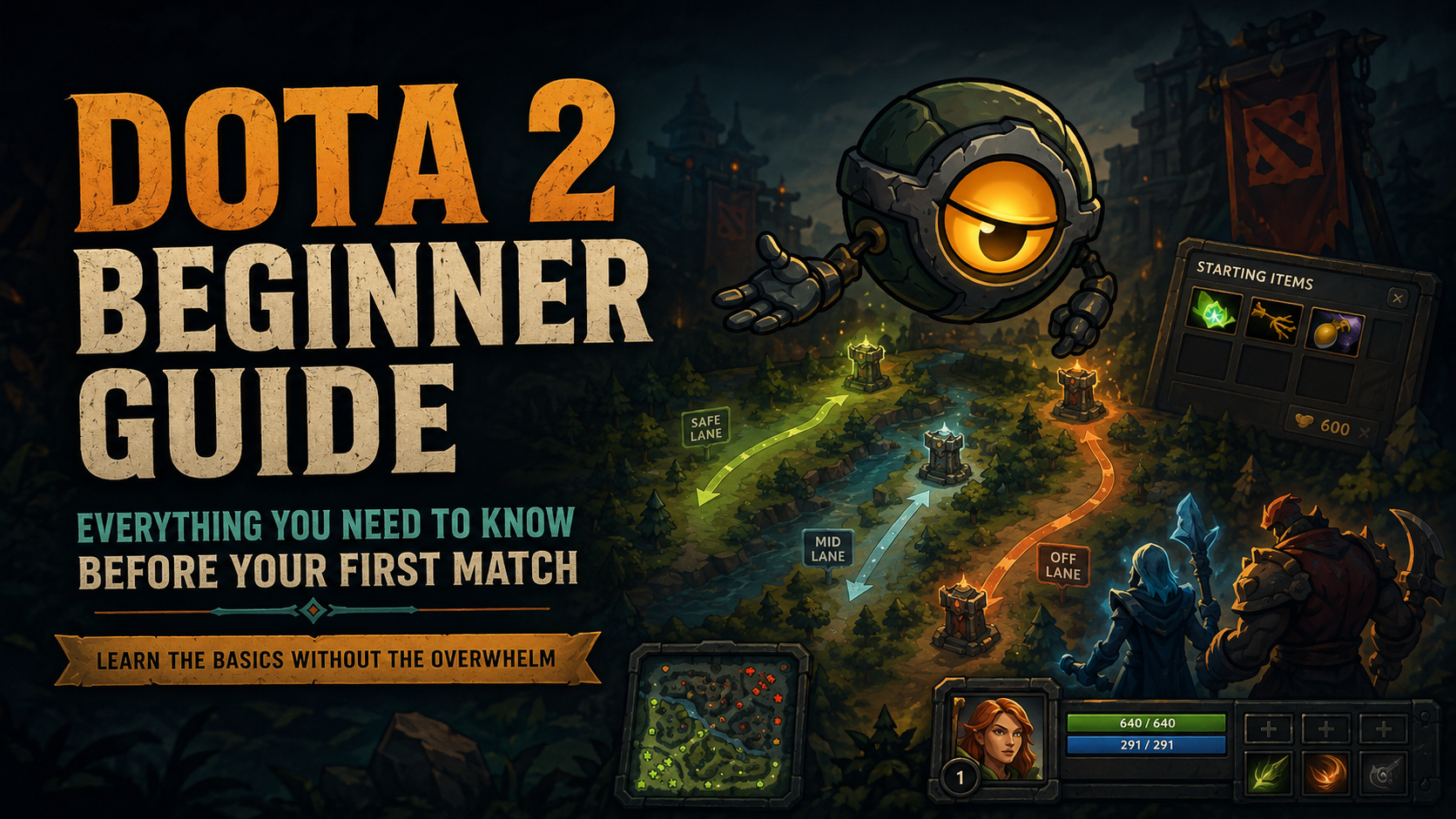
The Dota 2 map is divided between two teams: Radiant (bottom-left, green) and Dire (top-right, red). Each base has an Ancient, a large structure in the middle. Your goal is to destroy the enemy Ancient. Your team loses if yours falls first.
Between the bases are three lanes: top, mid, and bottom. Creeps from both sides spawn every 30 seconds and march down these lanes, fighting each other automatically. Your job as a hero is to fight alongside them, kill enemy heroes, and eventually push into the enemy base.
The jungle fills the space between lanes. It contains neutral creep camps that you can farm for extra gold and experience. A large neutral monster called Roshan sits in a pit on the river. Killing him gives your team a significant advantage.
The 5 Roles Explained
Every team runs five distinct roles. Understanding what each one does tells you how to play them.
Carry (Position 1): The carry is your team's main damage dealer in the late game. They start weak and farm gold to build powerful items. Carries need protection in the early game and space to farm. Their job is to win fights once they have their core items.
Mid (Position 2): The mid laner plays alone in the middle lane against the enemy mid. They get more experience and gold than most roles, which lets them hit power spikes early and create pressure across the map. Mid heroes are often playmakers who dictate the tempo of the game.
Offlane (Position 3): The offlaner plays in the most dangerous lane, often 1v2 against the enemy carry and support. Their job is to survive, disrupt the enemy carry's farm, and scale into a durable frontliner. Offlaners are usually tanky heroes with crowd control.
Soft Support (Position 4): The soft support roams the map, sets up kills, and helps teammates in multiple lanes. They buy some support items but can also build towards damage or utility depending on the game state.
Hard Support (Position 5): The hard support buys almost entirely utility items and wards. Their job is to protect the carry, control vision across the map, and make space for the team to farm safely. Hard supports sacrifice personal resources for team benefit.
What to Do in Your First 10 Games
Your goal in the first 10 games is not to win. It is to understand what is happening. Every game you play, pick one thing to focus on and ignore everything else.
Game 1-2: Just try to last hit. Click on enemy creeps right before they die to collect the gold. This is the core mechanical skill of the game and it takes hundreds of games to get right.
Game 3-4: Pay attention to where you are on the map. Are you in a safe position? Can you be attacked from multiple directions? Start thinking about your positioning before committing to anything.
Game 5-6: Buy the items your hero guide suggests, in order. Do not improvise. Just follow the build once to understand how items work together.
Game 7-10: Start watching the minimap every few seconds. Where are the enemy heroes? If you do not know where three of them are, be cautious.
That is it. Four things across ten games. If you try to fix everything at once, you will fix nothing.
5 Beginner-Friendly Heroes for Each Role
Starting with simpler heroes makes the learning process significantly faster. Here are good options for each role:
Carry: Wraith King, Juggernaut, Dragon Knight, Sniper, Ursa. These heroes have straightforward kits and forgiving item builds.
Mid: Viper, Dragon Knight, Zeus, Lina, Pugna. These heroes are durable in lane and easy to understand mechanically.
Offlane: Tidehunter, Dragon Knight, Axe, Underlord, Bristleback. Tanky heroes that can survive a difficult lane without needing to play perfectly.
Soft Support: Lion, Shadow Shaman, Crystal Maiden, Ogre Magi, Earthshaker. High-impact crowd control that does not require precise execution.
Hard Support: Lich, Crystal Maiden, Dazzle, Warlock, Ancient Apparition. Strong defensive abilities and simple mechanics that free up your focus for learning game sense.
The Most Important Mechanics to Learn First
Last hitting is attacking enemy creeps right as they are about to die to collect gold. You only get gold if you land the killing blow. Practice this every game. Improve your score by 5 last hits per game as a milestone.
Denying is attacking your own creeps when they are below 50% health to prevent the enemy from getting gold and experience. It is a unique Dota mechanic that experienced players use to starve opponents in lane.
Pulling is used by supports. It means attacking a nearby neutral camp at a precise moment so the neutrals walk into the lane and kill your own creeps. This denies the enemy carry experience and resets the lane closer to your tower, making it safer for your carry to farm.
These three mechanics define the early game. Getting comfortable with them will put you ahead of most new players within your first 50 games.
What NOT to Do
Do not feed intentionally or carelessly. Dying gives the enemy gold and experience. Every death sets your team back. Play cautiously, especially in the early game when your hero is weak.
Do not abandon games. Leaving a match before it ends penalises your account and ruins the experience for your teammates. Even if the game is going badly, stay and learn from it.
Do not blame your teammates. Dota players have a reputation for being hostile, especially to new players. Ignore it. You will play better when you are focused on your own game rather than on what others are doing wrong.
Do not skip the tutorial. Dota 2 has an in-game tutorial and training modes that teach the basics in a controlled environment. Use them before queuing into real matches.
Using DotaMirror to Learn From Your Mistakes
Even as a beginner, reviewing your mistakes is the fastest way to improve. After each game, paste your Match ID into DotaMirror and read the analysis.
The report will tell you specifically what went wrong: where you died, how your farm compared to benchmarks, which fights you should have avoided. As a new player, you do not need to fix everything at once. Focus on the single priority the report highlights and work on that in your next game.
Most new players improve slowly because they repeat the same mistakes without noticing them. A quick post-game review changes that. It turns each match into a lesson rather than just another result.