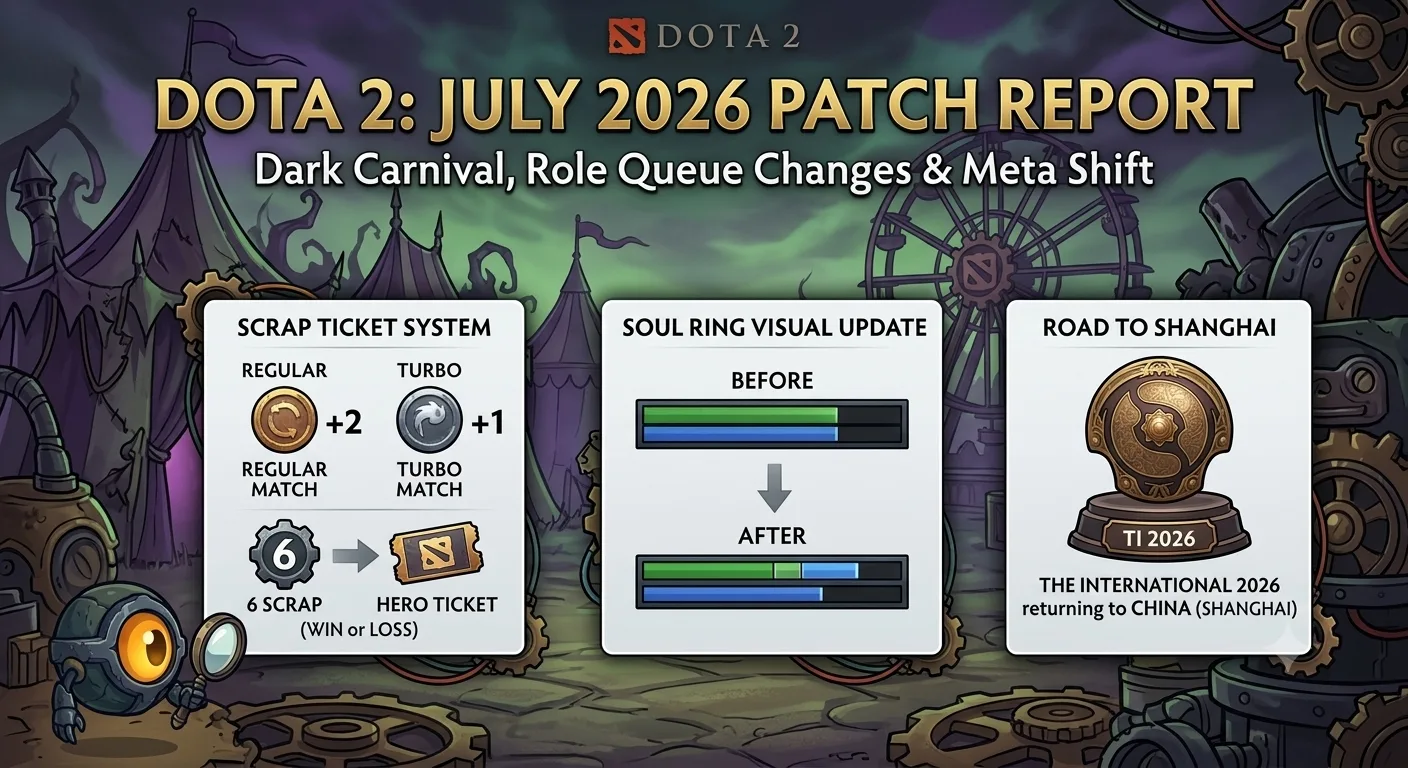
A Quiet Patch That Says a Lot
Early July 2026 is an unusual moment in Dota 2. The Dark Carnival event is still running, The International is heading to Shanghai in August, and in between the two headlines Valve has shipped a set of smaller changes that most players scrolled past: a rework of how the event rewards you, a meaningful Role Queue adjustment, and a small but genuinely useful UI change to Soul Ring.
None of these change the hero pool or the item meta on their own. All of them change how you queue and how you read your own games - which, if you care about improving, matters more than most balance notes. Here is what changed, and what to actually do with it.
How the Dark Carnival Scrap System Works
The Dark Carnival's reward currency is Scrap, and the economy is simple:
| Activity | Scrap earned |
|---|---|
| Regular match | 2 Scrap |
| Turbo match | 1 Scrap |
| Hero ticket of your choice | costs 6 Scrap |
Two details are worth pausing on. First, Scrap is earned win or lose. Second, the Hero ticket is of your choice - you are not gambling on a random drop, you are saving toward a specific reward.
That sounds like housekeeping. It is actually good design with a real effect on player behavior.
Why "Win or Lose" Rewards Change How You Queue
Event rewards that only pay out on wins create a subtle incentive problem: they push you to keep queueing when you should stop. You lose two games, you are tilted, and now the event is whispering that the session was "wasted" unless you get a win before logging off. That is exactly the mental state that produces a third loss.
Scrap removes that trap. A loss earns the same 2 Scrap as a win. The event never gives you a reason to queue one more game in a bad state, and it never punishes you for ending a session early.
The coaching takeaway is the mindset behind the design, not the Scrap itself: treat losses as paid, not wasted. A loss you review is worth more to your long-term MMR than a win you forget. The event now literally pays you either way - so the only thing that separates a useful loss from a useless one is whether you look at what happened.
Turbo's Half Rate Is a Signal, Not an Insult
Turbo earning 1 Scrap instead of 2 tells you how Valve weighs the mode: it counts, but it counts less. That maps well onto how you should use Turbo for improvement.
Turbo is excellent for learning hero mechanics, testing item builds, and warming up. It is a poor place to practice the skills that decide ranked games - lane equilibrium, farm scheduling, when to pressure the map - because accelerated gold and compressed timings change all of those answers. If you find yourself grinding Turbo purely for event progress, notice that the math does not even favor it: two Turbos roughly equal one regular match in Scrap and take a comparable chunk of your evening.
Play Turbo when Turbo is the right tool. Queue regular matches when you want the Scrap and the practice that transfers.
The Role Queue Change: One High-Demand Role Is Now Enough
The Role Queue adjustment is the most practically significant change of the batch. Previously, if you wanted to queue without spending one of your limited Role Queue Games, you had to select both high-demand roles. Now, selecting one high-demand role is enough.
Under the old rule, protecting your Role Queue Games often meant committing to two roles you did not actually want to play, and your "flexible" queue became a coin flip between two off-roles. The new rule lets you pair one high-demand role with the role you are genuinely trying to improve at.
That enables the single most underrated improvement habit in Dota: role consistency. Playing one role for a stretch of games is how patterns become visible - the same lane matchups, the same timing windows, the same recurring mistakes. Spread across three roles, ten games teach you three shallow lessons. Concentrated on one role, ten games teach you one deep one.
So use the change deliberately: pick the high-demand role you most want to master, make it your anchor selection, and let your queue times and your review habit both benefit.
Soul Ring's New Mana Bar: Small UI, Real Decisions
Soul Ring now shows its temporary mana as a separate segment in the mana bar, instead of blending into your total.
If you have ever played a Soul Ring hero in a hard lane, you know why this matters. The item's whole identity is a health-for-mana trade on a short timer, and the old display made it easy to misread what you could actually afford to cast once the temporary mana expired. Players routinely made lane decisions - a trade, a spell rotation, a retreat - based on a mana total that was about to shrink.
The segmented bar turns an invisible bookkeeping task into visible information. The habit to build on top of it: activate Soul Ring with a plan, not as a reflex. Click it when you know which spell the temporary mana is buying, and read the segment as a countdown on that decision. The same principle applies beyond one item - lane-phase resources (health, mana, regen consumables, cooldowns) are a budget, and the players who climb are the ones who spend that budget on purpose.
Why This All Matters More With TI on the Horizon
The International returns to China this August, in Shanghai. That has two knock-on effects for regular players.
First, the meta gets sharper from here. Qualifier and pre-TI Dota always bleeds into pubs - drafts tighten, popular picks shift, and lane matchups you have not seen in months start reappearing. Second, ranked queues get more serious as event hype pulls returning players back in.
In other words: the next two months are a high-information environment. More games are being played, patterns are shifting, and habits you build now get tested against a live, evolving meta rather than a stale one.
See How These Changes Show Up in Your Own Games
Patch notes tell you what changed. Your own matches tell you whether it is affecting you - whether your losses cluster on a role you only queue to fill, whether your lane phase falls apart on mana-hungry heroes, whether your Turbo habits are leaking into your ranked decision-making.
That is exactly what DotaMirror is for. Paste the Match ID from a recent game and you get a coaching report grounded in your actual data: laning numbers, itemization against the specific draft, teamfight participation, and the single highest-impact thing to fix next game. Run it on your last loss - the event already paid you Scrap for that game, so you might as well collect the lesson too.