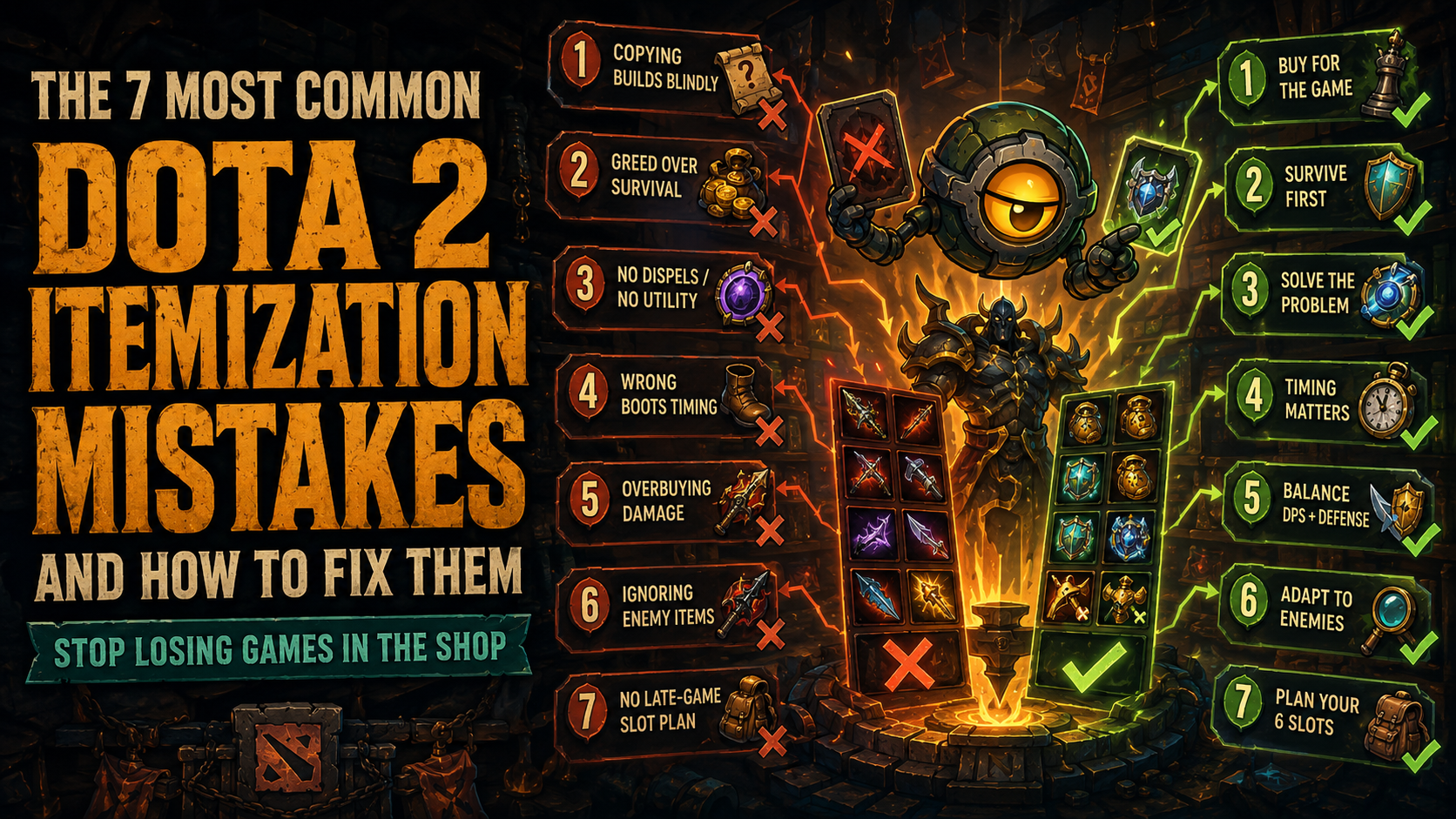
Wrong Items Cost More MMR Than Bad Mechanics
There's a persistent belief in Dota 2 that itemization is something you figure out once you understand the game well enough. Learn your hero's core build, execute it consistently, and improvement will follow.
This is wrong in two ways. First, the "right items" for any hero change every game based on the enemy lineup, your team composition, and where you are in the match. There's no universal core build that works in all situations. Second, bad itemization costs MMR at every rank. A carry with no Black King Bar into three disables loses fights they should win. A support who maxes utility when the team needs damage gets outscaled in every teamfight. The items you choose shape the outcome before the fight even starts.
Here are the seven mistakes that appear most often, at every bracket.
1. Building Your Comfort Build Regardless of the Game
Every player has a default build they reach for. Juggernaut players default to Battlefury. Invoker players default to Eul's into Aghanim's. These comfort builds reduce decision fatigue when you're learning a hero, and that's fine at first.
The problem comes when players execute the same build in games where it's wrong. If you're playing Anti-Mage into a Phantom Lancer and Terrorblade, your instinct might be to go Battlefury, but Manta Style into Butterfly wins those matchups and Battlefury loses them.
Before you buy anything, ask one question: "Is this item solving a specific problem that exists in this game right now?" If the answer is no, if you're building it because it's what you always build, you're itemising by habit instead of by reading the game.
2. Ignoring the Enemy Lineup When Deciding on BKB
The single most impactful itemization decision in most games is whether to build Black King Bar. And the most common mistake is treating BKB as either always mandatory or always skippable, rather than reading whether it's needed.
The rule is simple: if the enemy has three or more sources of disable that will land on you in fights, build BKB before your damage items. If they have primarily silences or roots (which BKB doesn't fully counter depending on timing), evaluate whether Linken's Sphere or Lotus Orb serves you better.
Beyond BKB: does the enemy have Bloodseeker? Build Heaven's Halberd or Linken's before Battlefury. Do they have Axe or Legion Commander? Your carry needs Blink Dagger or Hurricane Pike to create distance. Do they have heavy illusion carries? Radiance or Manta Illusion damage counters those matchups.
These adjustments take thirty seconds of thought at draft phase. They change the outcome of every teamfight.
3. Bad Item Timing: Right Items, Wrong Order
You can build exactly the right items in the wrong order and lose the game. Timing matters as much as the final item choice.
Example: you're playing mid, you decide you need Eul's Scepter for control. Instead of buying Bottle first, you rush Eul's. By the time you have it, you've died three times from running out of mana in lane, your tower fell at 8 minutes, and the enemy mid is roaming. The correct sequence was Bottle, then Power Treads, then Eul's. Bottle addresses the immediate problem before you build toward the solution.
When evaluating item order, ask: "What problem do I need to solve right now, in the next five minutes?" That problem should determine your next purchase, not your end-game build state. The answer changes every few minutes as the game develops.
4. Skipping Utility Items in Favour of Pure Damage
This is the most common mistake in the 3000-4000 MMR range. Players understand that damage wins games. What they underestimate is how often utility enables the damage to land at all.
A carry with Manta Style, Butterfly, and Eye of Skadi has more raw damage than one with Manta Style, Linken's Sphere, and Butterfly. But in a game where the enemy has Bane, Witch Doctor, and Shadow Shaman, the second build wins fights and the first build gets chain-disabled to death before landing a single attack.
Utility items are preventive. They solve a problem before it destroys you. Damage items are only useful once you're alive long enough to deal damage. When the enemy has the tools to prevent that, utility wins every time.
5. Not Adjusting Mid-Game When the Game Changes
Most players lock in a build at the start and execute it mechanically without re-evaluating as the game develops. This is one of the most costly habits in Dota 2.
At 20 minutes, the game looks completely different than it did at draft. Maybe the enemy support bought Glimmer Cape and now your team can't find kills in smokes. Maybe your team has snowballed and you don't need the defensive item you planned. You need Aghanim's to close. Maybe you have 4000 gold and your original plan was Eye of Skadi, but your team is losing every fight. Satanic would let you sustain through their burst and turn those fights around.
The discipline: every five to seven minutes, take ten seconds and re-evaluate. "What does my team need most right now? What item solves that?" Do this consistently and your mid-game decision-making will improve faster than almost any other adjustment.
6. Supports Defaulting to Full Utility When the Team Needs Damage
Support itemization gets very little strategic thought at lower brackets. Most supports build the same items every game: Arcane Boots, Glimmer Cape, Force Staff, maybe Lotus Orb. These are good items. They're not always the right items.
There are games where your team's damage output is insufficient to kill enemies before they use their cooldowns and disengage. In those games, a support who builds Rod of Atos, Dagon, or even just a Veil of Discord becomes the decisive factor in fights. Look at the scoreboard. If your team's highest-damage dealer is doing 300 DPS and the enemy has three tanky cores, someone needs to buy damage, and it might need to be you.
Read the game. Build what the game needs, not what feels safe.
7. Selling Items Instead of Adjusting Build Order
When players realise they've made an itemization mistake, many go straight to selling and rebuilding. This is almost always wrong. Selling items costs you a 25% tax on every gold piece, and you've already paid the opportunity cost of the time spent farming them.
Instead of selling, ask: "What can I add to what I already have?" If you have Phase Boots and realise you need Arcane Boots for the mana, that's a genuine sell situation: the items conflict. But if you have Treads and a Maelstrom and you realise you need survivability, the answer isn't selling Maelstrom. Pause the Mjollnir progression, build Linken's Sphere, then return to Mjollnir after.
Work with what you have. Adjust forward, not backward. The compounding cost of selling items is much higher than the discomfort of a slightly suboptimal build for a few minutes.