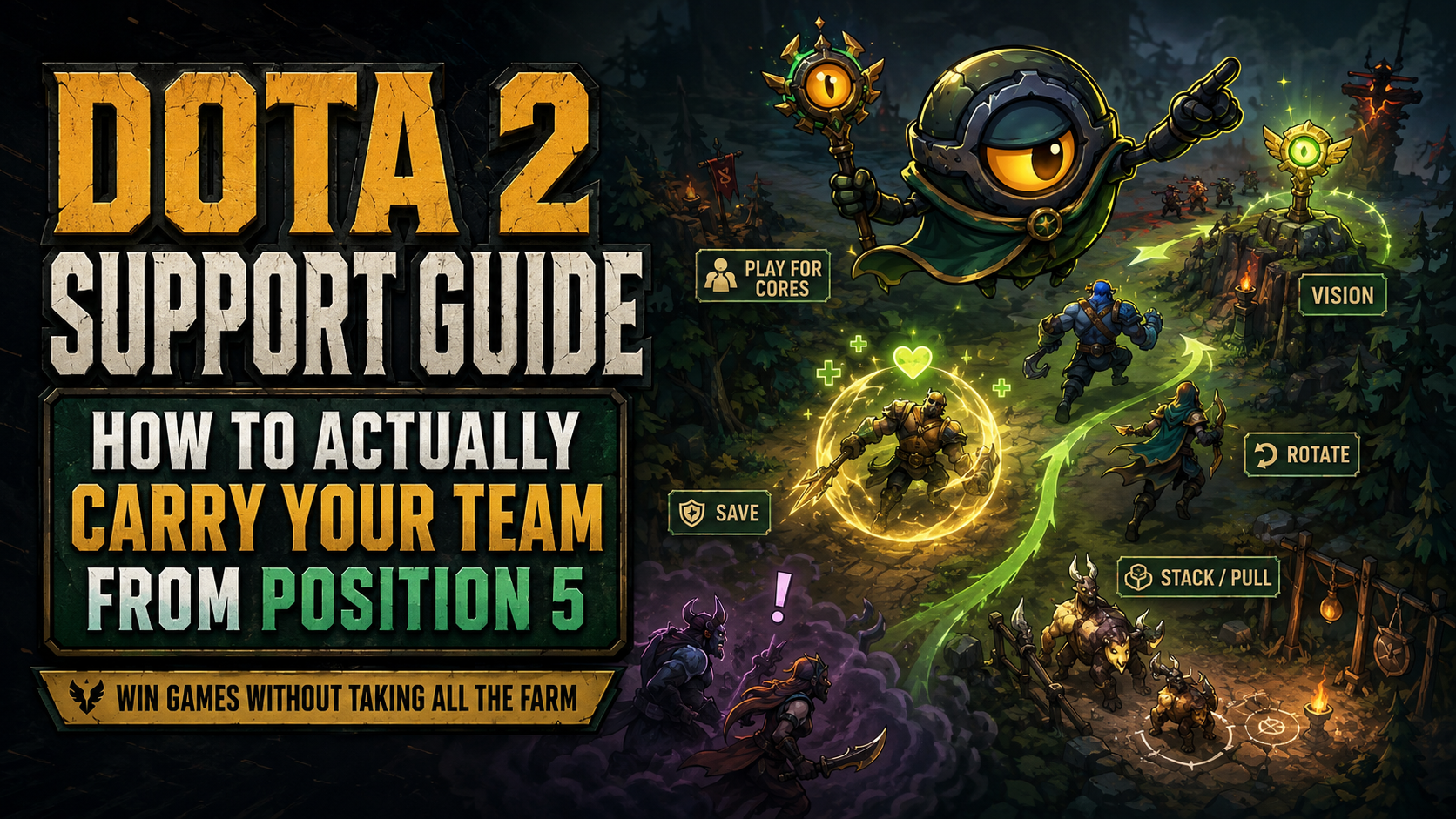
Support Is the Hardest Role to Play Well
Most new players avoid support because it sounds passive. You buy wards, you heal your carry, you die first in fights. That is the surface-level description and it is almost entirely wrong.
Support is the role that requires the most game knowledge of any position. You need to understand every hero's power spike, manage vision across the entire map, track enemy movements from limited information, create kill opportunities in lane, and make rotations that change the trajectory of the game, all without any reliable farm to fall back on. When you play support well, your team wins fights they should lose. When you play it badly, your carry starves, your team is always fighting blind, and you spend the whole game reacting instead of creating.
The players who master support tend to have a much deeper understanding of Dota than those who only play cores. If you want to climb MMR and understand the game more completely, learning to play support well is one of the most effective paths available.
Position 4 vs Position 5: Two Different Jobs
Support is not one role. It is two, and confusing them is one of the most common mistakes in the bracket.
Position 5, the hard support, has one priority in the early game: make the carry's lane safe and efficient. You spend your gold on consumables and wards. You pull camps to manipulate creep equilibrium. You harass the enemy offlaner. You sacrifice yourself when necessary to keep your carry alive. You are the reason your carry gets to farm in peace.
Position 4, the soft support, has more freedom and more responsibility to create impact. You start in lane but your job is to leave it. You rotate to mid to secure kills. You set up ganks in the enemy jungle. You contest rune spots. You are the most active player on the map in the early game, and if you are standing next to your carry at the 10-minute mark, you have probably wasted the first phase of the game.
Before you queue a support game, decide which of these two jobs you are doing and play accordingly. Most players blur the line and end up doing neither well.
Ward Placement That Actually Matters
Most supports place wards in the same spots every game regardless of what is happening. This is better than no wards, but it is not what good vision control looks like.
Vision should answer specific questions. Where is the enemy carry farming? Which direction is the enemy team likely to smoke from? Is Roshan alive and being contested? Your ward placement should respond to those questions, not follow a memorized pattern.
The two most impactful ward categories are: defensive wards that protect your team from getting caught, and offensive wards that let you see the enemy before they can see you. Prioritize defensive wards when you are losing. Prioritize offensive wards when you are ahead and want to take objectives.
Also deward. Buying a sentry and removing an enemy observer ward is often worth more than placing a new one, because it blinds your opponent at a moment when they feel secure. Most supports at lower brackets never buy sentries except to deward Roshan. That leaves the enemy with free vision for most of the game.
Pulling and Stacking: The Habit That Changes Everything
Pulling camps removes enemy creeps from the lane by aggro-ing a neutral camp at the right moment. This denies the enemy offlaner experience, resets the lane equilibrium closer to your tower, and lets your carry farm more safely.
Stacking is pulling a camp at exactly the right second so the original camp respawns while the first wave is still there. Done correctly, you create a massive camp worth several hundred gold that your carry can clear for a huge chunk of gold in one hit.
These two mechanics cost you no gold and no items. They require only timing and positioning. A support who pulls and stacks consistently creates hundreds of gold of extra farm for their carry every game, without ever buying a single farming item. If you are playing position 5 and not pulling at least once in the first 10 minutes, you are playing significantly below your potential.
When to Babysit and When to Roam
The answer to this question is almost always the same: babysit when your carry is in danger of losing the lane, and roam when the lane is stable enough that they can handle it alone.
The mistake most supports make is staying in lane far too long out of habit, or because the carry keeps asking for help with individual creeps. Your carry needs to learn to last hit. Your carry does not need you to hold their hand every time the enemy support harasses them. If the lane is safe, leave. Go find a kill. Pressure the enemy jungle. Help your mid. Every minute you spend standing idle next to a farming carry is a minute you could have been creating an advantage elsewhere.
The Post-Laning Phase Mistake
The most common support failure in mid-game is going passive. The laning phase ends, you feel like your job is done, and you start following your team around waiting for fights.
Your job is not done. It has shifted. Now you need to stack camps for your cores to clear, maintain vision around objectives before your team takes them, look for picks on isolated enemies, and create space for your team to farm safely by making the enemy nervous about where you are.
A support who creates two or three stack camps in the 10 to 20 minute window, and then buys a force staff or glimmer cape and uses it effectively in teamfights, is worth more to their team than almost any other player.
Item Progression
Buy what your team needs, not what feels good. Some general principles:
Arcane Boots into Tranquil Boots covers most early game mana and mobility needs. Force Staff is useful in almost every game because it saves cores from bad positioning and lets you disengage. Glimmer Cape is underrated and works in almost any lineup as a defensive tool. Lotus Orb is strong when the enemy has targeted spells they rely on. Ghost Scepter is cheap and buys you time when you are focused in fights.
The item nobody buys but almost always should: Boots of Bearing. The active aura provides enough haste to reposition your entire team. It is one of the highest-impact support purchases in the game.
Do not rush Aghanim's Shard on every hero just because it is on sale. Buy the item that solves the problem your team has right now.
5 Beginner-Friendly Support Heroes
Crystal Maiden: slow, obvious, but her spells are high impact and her ultimate creates instant teamfight presence even at low skill levels.
Lion: two hard disables and a high-damage ultimate make him forgiving to play because he creates opportunities even when you mistime things.
Warlock: his passive heal makes laning easy and his ultimate does significant work in teamfights with almost no execution requirement.
Lich: strong laning presence, his sacrifice denies a creep while giving you mana, and Frost Shield is one of the best defensive spells in the game for protecting teammates.
Ogre Magi: extremely durable for a support, his stun and slow are easy to land, and Multicast makes his spells unpredictably powerful in fights.
Using DotaMirror as a Support
When you review a support game, the things to look at are different from what a core checks. You want to know: how many fights did you participate in versus how many did your team fight without you? Were your wards providing vision at critical moments like Roshan attempts or smoke ganks? Did you stack camps and did your team clear them?
Paste your Match ID into DotaMirror and look specifically at the teamfight and objectives sections. Those sections will tell you whether your positioning and timing as a support is creating impact, or whether you are present but invisible in the moments that matter.