The Road to Shanghai Starts in Nine Days
The International 2026 will be played August 13-23 at the Oriental Sports Center in Shanghai — and for most of the competing world, the path there runs directly through the regional qualifier gauntlet that begins June 9. Seven teams already have their flights booked. The other nine spots are still up for grabs, and the competition for them is as brutal as TI qualifying has ever been.
This is your complete guide to the Dota 2 TI15 qualifiers: who got invited, who is fighting for the remaining slots, how the format works, and which storylines are worth paying attention to before the first series tips off.
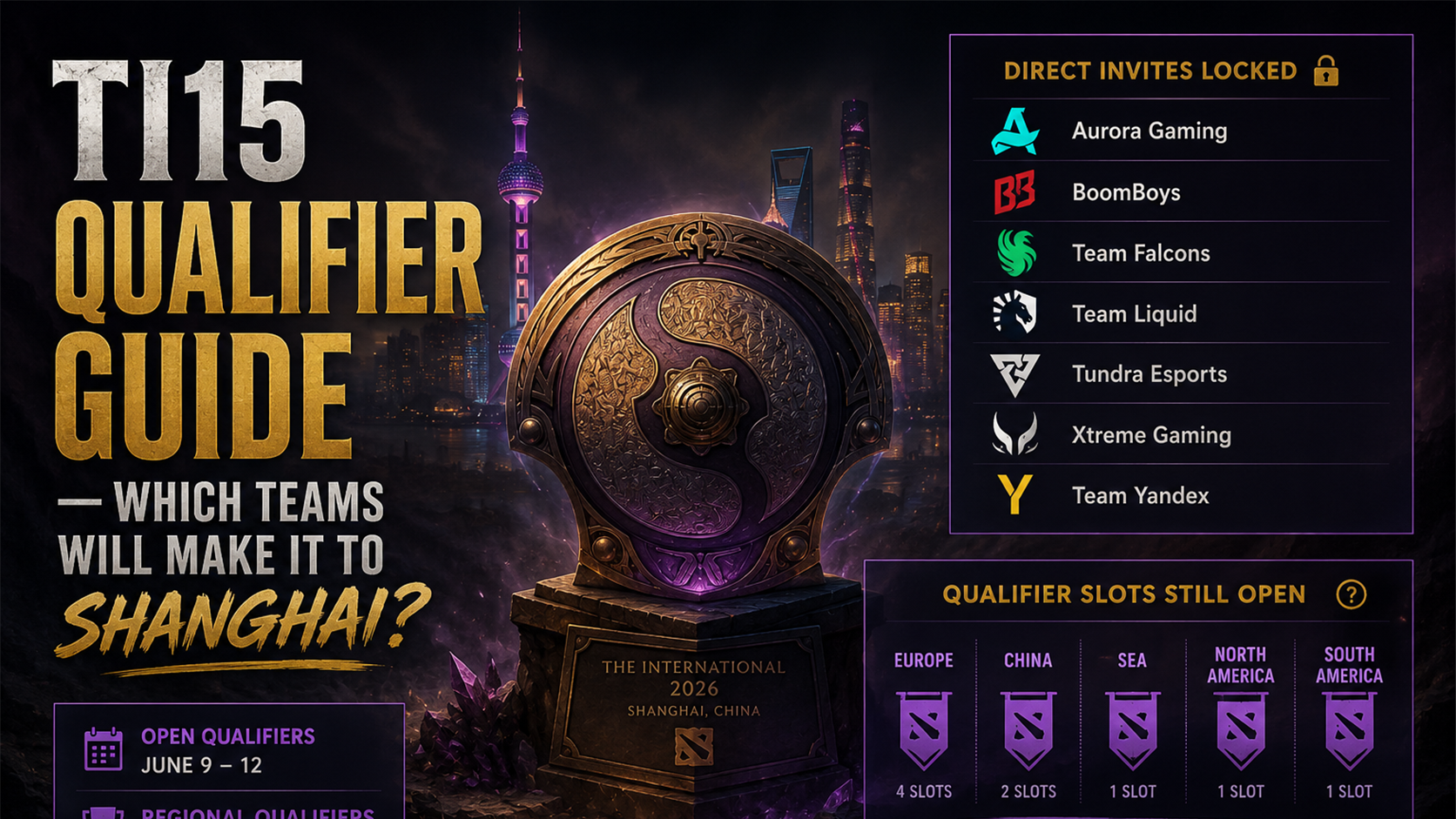
The 7 Direct Invites — and Why There Are Only 7 This Year
Valve trimmed the direct invite pool from 8 to 7 for TI15, opening up one additional qualifier slot across the field. The teams that earned invites based on DPC performance, tournament results, and Valve's own criteria:
- Team Falcons — defending TI14 champions, the obvious headliner
- Team Liquid — consistent top performers through the 2025-2026 season
- Tundra Esports — former TI11 champions, quietly rebuilt after a difficult stretch
- Aurora Gaming — earned their spot through a strong upper bracket run at the last Major
- Team Yandex — the strongest team to emerge from the Eastern European scene post-roster shuffle
- BoomBoys — formerly BetBoom Team, competing under a new name for TI15
- Xtreme Gaming — the strongest Chinese representative to receive a direct invite
The BetBoom to BoomBoys rebrand is worth a note. Valve's sponsorship guidelines for events held in China prohibit gambling-brand sponsors from being prominently displayed. Rather than sit out, BetBoom chose to rebrand specifically for TI15. The players and coaching staff are identical — only the name on the jersey changes.
The reduction from 8 to 7 invites is the other talking point. That extra slot flows into the qualifier pool, and given the caliber of teams in contention, it will matter.
How the Dota 2 TI15 Qualifier System Works
The path to Dota 2 Shanghai 2026 runs through two stages:
Open Qualifiers: June 9-12 Open to any registered team in the region. Hundreds of rosters enter; a handful advance. The format is typically double-elimination with best-of-one series in early rounds, switching to best-of-three as the bracket tightens. Teams that survive earn a spot in the Regional Qualifier.
Regional Qualifiers: June 15-28 The main event for Dota 2 TI15 qualifier spots. Invited regional teams join the Open Qualifier survivors in a double-elimination bracket played entirely in best-of-three. The number of slots allocated varies by region.
Results are final. There is no repechage and no wild card path once a team is eliminated from the Regional Qualifier.
Regional Breakdown: Who Gets How Many Spots
Nine total slots split across five regions:
| Region | Qualifier Slots | Notes |
|---|---|---|
| Europe | 4 | EEU and WEU merged into one bracket |
| China | 2 | Separate from the Xtreme Gaming invite |
| Southeast Asia | 1 | Competitive but condensed field |
| North America | 1 | Historically the most volatile spot |
| South America | 1 | SA Dota 2 has risen significantly in recent cycles |
The Europe allocation is the headline number. Four spots out of nine total, all from a single combined bracket that includes both Western and Eastern European teams. This was a deliberate Valve decision to avoid giving Europe a disproportionate guaranteed representation while also acknowledging that Europe produces more TI-caliber teams than any other region.
The practical effect: European teams that would comfortably qualify in a smaller field will go home instead. Expect upsets.
European Qualifier: The Region That Will Hurt Someone
The merged European bracket for Dota 2 TI15 qualifiers is shaping up to be the most competitive regional qualifier in the event's history. Teams expected to contend for the four available slots:
Team Spirit — TI11 champions, rebuilt around a core that has consistently performed at the top of European competition. They enter as one of the clear favorites and a loss here would be a significant storyline.
Team Vision (formerly PARIVISION) — rebranded but largely the same roster that proved dangerous at multiple Majors. A team that consistently overperforms their invite seeding.
MOUZ — the German organization has assembled a genuinely threatening lineup. They enter the European qualifier as legitimate contenders rather than hopefuls, which marks a shift from where they were 18 months ago.
Natus Vincere — NaVi's Dota 2 roster has gone through changes but the organization's commitment to the title remains. Getting to TI with a roster that has had limited time together would be a significant achievement.
Nigma Galaxy — Kuro's team has one of the most experienced cores in the European scene. Their ceiling at TI has been proven. Their floor in qualifier formats is the uncertainty.
Virtus.pro — another historically significant European organization that will be fighting for one of the four spots. VP's qualifier performance has been inconsistent, but roster chemistry and individual skill are both present.
Four spots. Six legitimate contenders. At least two teams from this list will not be going to Shanghai 2026.
Other Regions to Watch
China (2 slots): With Xtreme Gaming already invited, the remaining two spots will come from a Chinese regional scene that has been quietly building depth. PSG.LGD and Azure Ray are the teams most expected to convert, but Chinese qualifier upsets have produced some of TI's most interesting storylines in recent years.
Southeast Asia (1 slot): SEA has one spot and a competitive bracket. Talon Esports has been the most consistent regional representative over the past two cycles, but teams like Blacklist International and RRQ have the firepower to challenge. One slip ends it.
North America (1 slot): NA has one slot and historically limited depth, but the teams that do compete at the top of the region have proven capable of winning games at TI. nouns and 4 Zoomers are expected to be the primary contenders.
South America (1 slot): SA Dota 2 has developed faster than most predicted. beastcoast and Thunder Awaken remain the benchmark teams for the region, with multiple capable challengers behind them.
What Makes TI15 Qualifiers Different
Three things set the Dota 2 TI15 qualifiers 2026 apart from previous cycles:
Fewer invites, more pressure. Seven direct invites instead of eight means one additional team goes through the gauntlet. Given the quality of team on the TI15 invite list, whoever would have been that eighth invite is now fighting through a regional qualifier. That shifts the difficulty ceiling upward for everyone in the bracket.
The merged European bracket. This is new for TI15. Previous editions kept EEU and WEU as separate qualifying paths. Combining them forces the two strongest European teams to beat each other for the same pool of slots. It also creates bracket scenarios where two historically rival organizations might meet in an elimination series with a TI spot on the line.
The rebranding question. BoomBoys competing as BoomBoys instead of BetBoom is a first for a TI event. How the team handles the identity shift mid-season, and whether it affects their performance or team cohesion, is an open question that only results will answer.
When to Watch
Open Qualifiers run June 9-12. Regional Qualifiers run June 15-28. The full bracket draws and streaming details will be announced on the official Dota 2 social channels ahead of June 9.
The European Regional Qualifier will be the highest-stakes viewing of the pre-TI period. When it locks in, watch it. You will see teams that will matter at TI15 in Shanghai, and teams that should have been there instead.