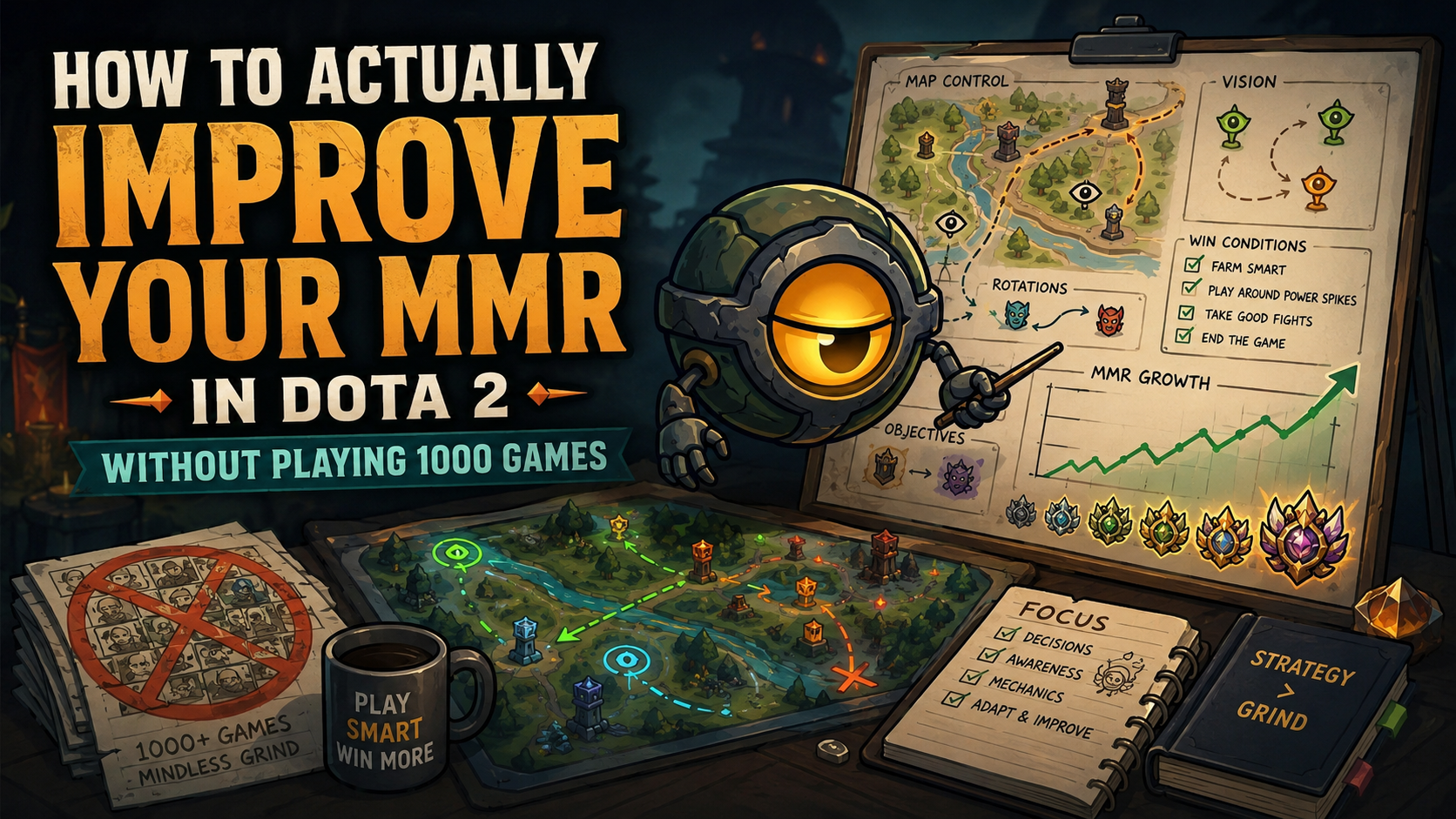
The Problem With Grinding Games
Most players who want to improve focus on one thing: playing more games. The logic seems reasonable. You get better by doing, right? In Dota 2, that's only half true. You get better by doing and reflecting. Without reflection, you're just reinforcing your current habits, including the bad ones.
At 2000 MMR, players lose because they don't know what they don't know. At 3000, they lose because they know what they should do but can't execute under pressure. At 4000+, they lose because they understand the game but keep repeating the same subtle mistake every game without recognising it. More games fixes the execution problem. It doesn't fix the knowledge and habit problems.
Focused Practice vs Mindless Grinding
There's a difference between playing 10 games and practicing for 10 games. The distinction is simple: did you have a specific thing you were trying to improve?
Mindless grinding looks like this: queue, play, check result, queue again. Focused practice looks like this: before you queue, decide one specific thing you're going to pay attention to. During the game, you evaluate decisions through that lens. After the game, you assess whether you improved at that one thing.
Professional players in Dota and every other competitive game call this deliberate practice. You isolate one skill, work on it consciously, and measure whether it got better. You don't try to fix 12 things at once. One thing. Every game.
The hard part is that mindless grinding feels productive because you're playing. The games add up. But if you play 500 games making the same positioning mistake, you've practiced that mistake 500 times. It's now more ingrained, not less.
Review One Mistake Per Game
You don't need to watch back every replay. You don't need full VOD reviews. You need one honest moment of reflection per game.
Right after a game ends, before you click queue again, ask yourself: what was the single decision that cost my team the most? Not "my supports didn't ward" or "carry went AFK". What did you do wrong?
Common honest answers look like:
- "I teleported to a fight instead of staying to farm the wave that would have given me BKB timing."
- "I had all five enemies visible for Black Hole but waited too long. By the time I used it, two had walked away."
- "I pushed mid instead of rotating when my team was fighting a 4v5 near Roshan."
Write it down. One sentence. Then queue again. After a week of this, you'll have a list of your recurring patterns. Those patterns are your actual weaknesses. Not the generic ones that Dota guides talk about, but the specific tendencies that live in your gameplay. That list is your training plan.
Hero Pool Discipline
One of the fastest ways to stall your climb is playing too many different heroes. Dota 2 has two distinct layers of skill: game knowledge and hero mechanics. When you pick up a new hero, you're rebuilding the mechanics layer from scratch while simultaneously trying to apply game knowledge. You're doing two hard things at once, and you'll fail at both.
The optimal hero pool for climbing is three heroes. Two you know deeply. One you're actively learning. That's it.
More importantly, build redundancy into your pool. Don't pick three carries. Have an answer for different game states: a hero that works when your team needs hard control, one that works when you want to farm and scale, one that works when you're behind and need to scrape wins. This way the draft rarely forces you into unfamiliar territory.
The discipline is resisting the temptation to play whatever is strong in the current meta. Unless your heroes become genuinely unplayable, stick with them. Three weeks minimum before evaluating whether a swap is worth it. Mastery compounds. Each hour on a hero builds on the last.
Fatigue Kills MMR
This is obvious but almost nobody actually acts on it: stop playing when you're tilted or tired.
The data from high-level players is consistent: win rate drops after consecutive losses and after extended sessions. The mechanism is simple. Dota requires sustained decision-making over 40-60 minute periods. When you're mentally fatigued, your decision quality drops in subtle ways that you can't feel while it's happening. You delay rotations slightly. You misread fight commitments. You overcommit because you're frustrated.
A practical rule: if you've lost two games in a row, close the client for at least an hour. The MMR you lose while tilted takes three to four wins to recover. The MMR you protect by stopping costs you nothing.
The One-Thing-to-Fix Approach
Here's the whole framework summarised:
Before each game, pick one specific thing to focus on, based on what you identified in your last game's reflection. Play the game with that focus. After the game, assess whether you improved at that one thing and identify the next thing to work on.
This is slower to feel than grinding. You won't shoot up 500 MMR in a week. But after a month, you'll notice your mistakes have changed. The ones you made in week one are gone. New ones have appeared: higher-order problems that you couldn't even see before because the basics were getting in the way. That's what actual improvement looks like.
The tools that accelerate this most give you specific, honest feedback about your decisions. Not surface stats, not vague encouragement. After every game, you want a clear answer to one question: what was my most impactful mistake and what should I have done instead? Answer that consistently, and the MMR follows.