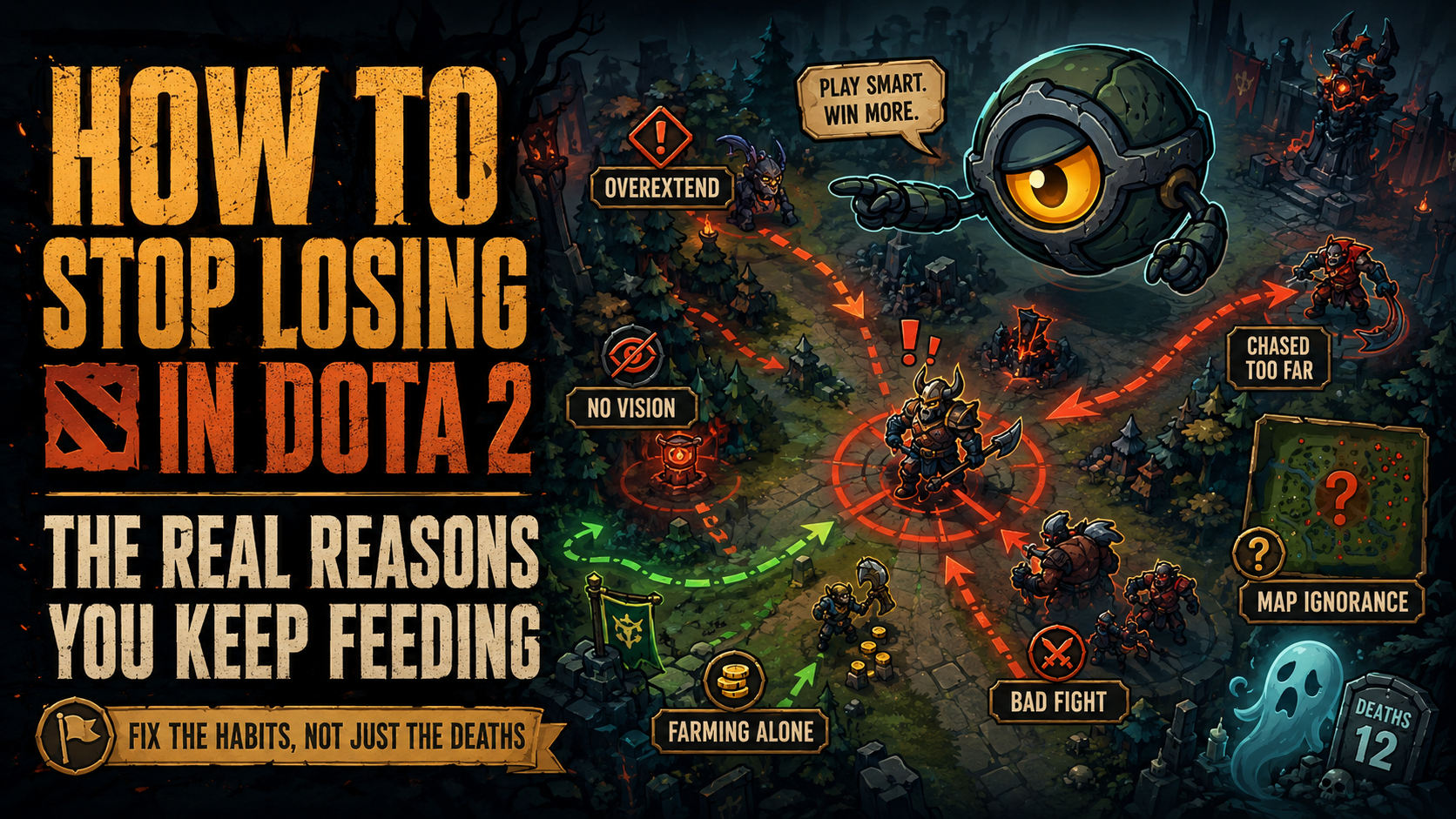
It's Not Your Teammates
Every stuck Dota player tells the same story. The support didn't buy wards. The carry fed in lane. The offlaner kept dying alone. The mid lost to a cheesy cheese strategy. And yet somehow, five people on the enemy team managed to work together well enough to win.
The uncomfortable truth is this: if you have played 500 games and your win rate has barely moved, your teammates are not the variable. You are.
This does not mean you play badly every game. It means there are specific, repeatable mistakes you make that you have never identified because you are too busy cataloguing what everyone else did wrong. Blaming teammates is the most effective way to never improve, because it shifts your attention away from the only thing you can actually control: your own decisions.
The first step to stopping the losing streak is accepting that every game you lose, you contributed to that loss in some way. Sometimes it was small. Sometimes it was decisive. Until you start looking for your part in each defeat, you cannot fix it.
The Tilt Loop
Losing one game is fine. Losing two in a row starts to feel personal. By game three, you are playing angry, rushing decisions, taking fights you should not take, and making the same mistakes faster.
This is the tilt loop, and it is responsible for more rating loss than any single gameplay mistake. The mechanics are simple: frustration narrows your focus, narrow focus degrades decision quality, degraded decisions produce more losses, more losses deepen the frustration.
Breaking the loop requires recognizing it early. The signal is usually an emotional one. If you notice yourself typing in all chat, blaming teammates in your head, or queuing again immediately after a loss without any reflection, you are in it.
The fix is a hard stop. Close the client. Do something else for at least an hour. Come back when the emotional charge has cleared. This costs you one session. Staying in the loop costs you rating across the entire week.
Decision Fatigue After Game Three
There is a physical reason your Dota gets worse as the session gets longer. Decision-making is cognitively expensive. Every choice you make in a match, whether to fight or farm, which camp to stack, whether to respond to a smoke, draws from a limited mental budget.
After two or three full-length games, that budget is depleted. You start defaulting to habit and instinct rather than active reasoning. In Dota, where the correct choice changes every 30 seconds, instinct is almost never enough.
Most players notice they are tired but queue one more game anyway. That game is almost always a loss, because the opponent who queued fresh has a systematic advantage in every decision point of the match.
A practical ceiling for a productive session is three games. After that, the expected value of continuing is negative unless you have taken a real break, not just a five-minute queue wait.
The "I Was Winning But..." Problem
A lot of losses at every rank follow the same structure: you won your lane, you had a gold lead at 15 minutes, and then something went wrong and the enemy came back to win. Players often describe this as bad luck or their team throwing. Usually it is neither.
Converting an advantage into a win is a specific skill. It requires understanding which objectives matter most at a given moment, recognizing when a fight is worth taking versus when to take a building, and not getting baited into unnecessary skirmishes just because you feel ahead.
The most common conversion mistake is continuing to farm when you should be closing the game. A lead at 20 minutes does not automatically become a win at 40 minutes. Enemy heroes scale. Your items stop being relatively dominant. The window closes.
If you keep winning lanes and losing games, look specifically at what you did between 20 and 35 minutes. That segment is where most games are decided, and it is usually where the mechanical leader fails against the strategic thinker.
Why More Games Without Review Does Nothing
Grinding games feels productive because it feels like practice. The match count goes up. You get more experienced with your heroes. But if you are repeating the same decision patterns every game, you are not practicing improvement. You are practicing your current ceiling.
Improvement requires a feedback loop. You make a decision, you observe the outcome, you update your model of the game. Without the observation step, the loop does not close. You just keep making the same decisions at increasing speed.
The players who climb fastest are not the ones who play the most games. They are the ones who treat each game as a source of data about their own patterns. Even five minutes of honest reflection after a match, just identifying the one decision that cost you the most, compounds into massive improvement over a month.
The Habit That Actually Separates Improving Players
After every loss, before you queue again, answer one question: what was the single decision I made that had the most negative impact on this game?
Not what your teammates did. Not what the enemy did. What did you do, or fail to do, that hurt your team the most.
Write it down. One sentence. Then queue.
After a week of this, you will have a list. That list is your personal improvement roadmap, built from your actual games, not from generic guides. The patterns on that list are the things keeping you stuck.
Using DotaMirror to Find Your Real Loss Patterns
The hardest part of post-game review is that you cannot always see your own mistakes. You are too close to the game. You remember the moments that frustrated you, not necessarily the moments that mattered most.
This is where an objective analysis helps. Paste your Match ID into DotaMirror and read what it finds. It looks at your farm windows, your fight participation, your item timing, and your positioning data, then tells you specifically what cost you the most.
Over multiple games, the patterns become clear. Not "I need to get better at Dota" but "I keep joining losing fights in the mid-game instead of taking available objectives." That is something you can actually fix.
When to Stop for the Day
Stop playing when you have lost two games in a row. Stop playing when you notice yourself typing aggressively. Stop playing after three games regardless of results. Stop playing when it stops feeling like a game and starts feeling like a job.
The goal is not to play as many games as possible. The goal is to improve. Those two things require different approaches, and confusing them is one of the most common reasons players stay stuck for months or years at the same rank.